


Reduced cost, increased collaboration, and efficiency are reasons why modern-day tech companies are switching from on-premises IT infrastructure to cloud computing.
Cloud computing allows you to rent databases, servers, and computers and use them to store data in the cloud so your customers can access your information from anywhere using an internet connection. This model removes the burden of managing your own IT infrastructure. It saves you money and time and allows you to upscale or downscale your IT infrastructure at any time while paying only for what you use.
The cloud service market is vast and bustling with vendors. From market giants like Amazon to smaller players like ProfitBricks, choosing the right provider for your business can be difficult. So to help you make the right decision, this article compares two industry giants, Amazon Web Services (AWS) and Google Cloud Platform, to show you how they stack up.
- 01 Google Cloud (GCP) vs AWS Activate: overview
- 02 What's the difference between Google Cloud (GCP) and AWS Activate?
- 03 Google Cloud (GCP) pros and cons
- 04 AWS Activate pros and cons
- 05 Google Cloud (GCP) compared to AWS Activate
- 06 AWS Activate compared to Google Cloud (GCP)
- 07 Features comparison
- 08 Google Cloud (GCP) vs AWS Activate: Which is the best for your business?
- 09 Alternatives to Google Cloud (GCP) & AWS Activate
- 10 Promotions on Cloud Computing software
Start saving on the best SaaS
Secret has already helped tens of thousands of startups save millions on the best SaaS like Microsoft Teams, Google Workspace & many more. Join Secret now to buy software the smart way.

01 Google Cloud (GCP) vs AWS Activate: overview
AWS was publicly launched in 2006 to provide on-demand cloud computing services to governments, companies, and individuals on a paid subscription basis. The platform offers a wide array of reliable and scalable tools and services to support the needs of modern tech-driven businesses. As one of the oldest cloud service providers, it boasts extensive industry expertise, a robust customer base, and a significant market share.
Google Cloud Platform (GCP) was launched many years after AWS—in 2011— and it runs on the same infrastructure Google uses internally for its end-user products like Gmail and Google Search. Despite being a latecomer, GCP has received wide adoption across the industry and is now recognised as a leading provider with the likes of Amazon and Azure.

Storage options
Both platforms offer advanced storage capabilities. While AWS S3 has better configuration management and object versioning, Google Cloud storage delivers faster speed, especially for users working with big data and analytics.

Google Cloud (GCP)
AWS Activate
Security and Compliance
GCP provides more advanced protection as it integrates with Google’s other security products like Google Identity Aware Proxy and Google Cloud Armor.
Google Cloud (GCP)
AWS Activate
Ease of use
GCP is far easier to use. It provides a more straightforward documentation, an intuitive interface and sane defaults that allow you to deploy anything in a few clicks.
Google Cloud (GCP)
AWS Activate
Compute services
Both platforms provide scalable Infrastructure-as-a-service (IaaS) where users can rent virtual machines to build and run applications without managing any underlying infrastructure.
Google Cloud (GCP)
AWS Activate
Databases
The two platforms support relational, NoSQL, and in-memory databases, with 99.99% SLA when deployed across availability zones.
Google Cloud (GCP)
AWS Activate
Integrations
AWS and GCP provide powerful API integration and management to enable you access and combine data from multiple sources.
Google Cloud (GCP)
AWS Activate
Network
They both offer good-quality networking features. However, Google shows exceptional speed in load balancing as it can run 0-1 million requests/second without pre-warming.
Google Cloud (GCP)
AWS Activate
Positive reviews
They both have happy customers and positive ratings across the board. But AWS generally has more reviews thanks to its larger customer base.
Google Cloud (GCP)
AWS Activate
Pricing plans
Both offer similar price plans. But GCP offers better discounts and a simpler billing structure, presenting the opportunity to be cheaper than AWS.
Google Cloud (GCP)
AWS Activate
Customer support
There are wide complaints about poor customer service from both companies.
Google Cloud (GCP)
AWS Activate
02 What's the difference between Google Cloud (GCP) and AWS Activate?

Google Cloud Platform
Google Cloud (GCP)
Cloud services by Google

Amazon Web Services
AWS Activate
Efficiently develop, deploy and maintain high-performance and scalable applications.
While Google Cloud Platform (GCP), a new offering from Google, is a collection of public cloud resources that focuses on high compute products like Big Query, Amazon Web Services is an established cloud service platform providing a range of services to support all kinds of IT needs.
The foundational service offered by GCP is called Compute Engine. Similarly, AWS calls its primary service Elastic Compute Cloud or EC2. Though they use different naming conventions, both products essentially provide users with Virtual Machines (VM) that function like physical computers and run any kind of operating system and applications.
Interestingly, AWS and GCP share similarities in how they deploy and manage virtual machines. For example:
- They allow you to customise the specifications of your VMs to fit your workload. You can select the amount of memory that suits your business needs, the number of vCPUs, the size and type of storage etc.
- You have the freedom to install a variety of operating systems on your instance.
- Both platforms provide auto-scaling features that automatically add or remove VMs based on application demand. This ensures your applications have all the resources they need to maintain performance without overspending.
- Users can create instances using machine images.
- You can launch and terminate instances on demand.
However, they both approach VMs differently. One such difference is that GCP offers live migration of virtual machines during system maintenance and upgrades without any user downtime while AWS does not. Another major difference is how they store images. Google Cloud stores images with Compute Engine, delivering the benefit of globally available machine images. AWS on the other hand stores its images in two different services—Amazon Simple Storage Service (S3) and Amazon Elastic Block Store (EBS). This way, Amazon machine images are always geo-locked and only available in specific regions.

Google Cloud (GCP)
Used by 11245 members
$2,000 in credits for 1 year if you never raised funds // $350,000 in credits for 2 years if you did
Save up to $350,000

AWS Activate
Used by 6104 members
Up to $100,000 in credits or 20-50% off your monthly spend through an AWS partner (must be spending $100+/month)
Save up to $300,000
03 Google Cloud (GCP) pros and cons
What are the advantages of Google Cloud (GCP)?
- Superior capabilities in state-of-the-art technologies like big data analytics, artificial intelligence and machine learning.

- Reliable future-proof infrastructure, the same one that powers the Google search engine.
- It offers excellent integrations with third-party services and other Google services
- It supports seamless collaboration for multiple users at once. The system can handle tens of thousands of users, accessing and editing a project at the same time from different countries.
- Thanks to its global infrastructure, Google Cloud is reliable. With its multiple servers, downtime is almost non-existent. On the rare occasion that a data centre is not available, the system falls back onto a secondary centre without any service interruptions.
- Excellent data backup and security. GCP provides four solid data backups. Whenever your application experiences a problem, it’ll be automatically backed up.
- Supports open-source technology and initiatives.
- Its extensive documentation and detailed API reference guide are widely appreciated by developers.
What are the disadvantages of Google Cloud (GCP)?
- It has fewer products/services compared to providers like Amazon.

- Its application engine is limited to PHP, Java, Python and Google Go.
- Even though it’s built on solid infrastructure, the platform is slow to innovate. Hence, it continues to lag behind competitors like AWS.
- GCP’s customer support isn’t great at handling customer issues—given the widespread complaints. Plus, the service is expensive.
Compare Google Cloud (GCP) to other tools


Google Cloud (GCP) vs Cloudflare

DigitalOcean vs Google Cloud (GCP)

Google Cloud (GCP) vs Firebase

Google Cloud (GCP) vs Google Drive

Microsoft Azure vs Google Cloud (GCP)

Google Cloud (GCP) vs IBM Cloud
04 AWS Activate pros and cons
What are the advantages of AWS Activate?
- The platform is aggressively updating its services at lightening fast speed. Whatever your IT needs are, AWS has an extensive suite of infrastructural applications to meet them.
- Due to its early entrance into the market, AWS has a more comprehensive network of data centres. This means customers can deploy applications in multiple regions around the world.
- AWS offers rapid deployment for applications with its Elastic Beanstalk service. It also offers quick cloud access with limitless capacity.
- The platform offers incredible flexibility. You can easily load any web app, use any programming language or run any software of your choice.
- AWS provides managed IT services to put more time back in your hands so you can focus on other parts of your business.
- It’s ideal for DevOps teams handling larger projects and having more experience managing and configuring infrastructure.
What are the disadvantages of AWS Activate?
- AWS is built for more advanced organisations and engineers. Its product range can be too much for startups or newcomers who are not very tech-savvy.
- The platform is known for experiencing common cloud computing problems, e.g. downtime when migrating, backup protection and control limits.
- The deployment process is lengthy and can take up to 15-20 minutes for even a simple website.
Compare AWS Activate to other tools

Cloudflare vs AWS Activate
IBM Cloud vs AWS Activate
Microsoft Azure vs AWS Activate
DigitalOcean vs AWS Activate

Scaleway vs AWS Activate

Vercel vs AWS Activate
05 Google Cloud (GCP) compared to AWS Activate
Google Cloud offers about 150 products and services spanning cloud computing, big data, networking and more. Amazon, on the other hand, has 200+ products and services covering the same domains. Compared to AWS, it may seem as though GCP is lagging. Yet, when it comes down to practical use and performance, GCP is robust enough to power and support all kinds of applications for the web, mobile, gaming and Internet of Things (IoT).
Is Google Cloud (GCP) better than AWS Activate?
 Is Google Cloud (GCP) better than AWS Activate?
Both AWS and GCP are excellent cloud platforms with their fair share of advantages and disadvantages. But choosing the right cloud service provider for your company comes down to your needs, goals and preferences. If you’re wondering which platform to use, GCP will be better for you if:
- You’re seeking cloud-based container tools. Google’s Kubernetes engine allows you to build, test and deploy applications quickly in any environment, whether a private data centre, public cloud or personal laptop.
- You’re invested in other Google products and services. It makes for a seamless integration.
- You’re building analytics/data-intensive applications. You’ll appreciate its BigQuery as it helps you analyse and manage your data with features like machine learning.
- You’re just starting with cloud computing, as the platform is easier to understand and navigate. It has an easier learning curve and better customer support than AWS.
What is Google Cloud (GCP) best used for?
GCP is best for:
- Companies that are direct competitors with Amazon and cannot use AWS.
- Companies keen on monitoring their infrastructure’s down and uptime. GCP’s operations suite gives you visibility into the performance of your applications and platform. You can set alerts to get notified when metrics are outside their expected ranges.
- Companies seeking unequaled throughput. Google’s global network offers 3X the throughput of AWS and Azure, the other top competing cloud providers.
- Developing cloud-native web and mobile apps.
- Migrating virtual machines without disrupting performance. Even though migration is a highly complex process involving many components, GCP allows for live migration of virtual machines while keeping your instances and application available.
Can Google Cloud (GCP) replace AWS Activate?
With the pace at which GCP is developing, there’s a possibility it could replace AWS as the leader in cloud computing. Despite coming into the market late, the platform has built a solid customer profile with hotshot organisations like PayPal, Bloomberg, Target and Goldman Sachs. This is because it relies on Google’s global infrastructure, which is already tested and trusted.
GCP has also proven reliable and capable of handling complex cloud infrastructural needs. Plus, the platform capitalises on some of AWS’ weaknesses, like ease of use and pricing. On the flip side, AWS isn’t slowing down. The platform is constantly innovating to maintain its position at the top of the food chain.
Is Google Cloud (GCP) cheaper than AWS Activate?
Google Cloud Platform prides itself on offering a relatively lower cost than Amazon and other cloud providers. However, comparing both platforms’ pricing is very complicated because the prices differ according to individual use cases, and both platforms have different structures and naming conventions.
Both AWS and GCP use the pay-as-you-go model differently. For a common cloud resource like compute, where both providers offer similar services, GCP charges per second with automatic sustained use discounts. On the other hand, AWS charges per hour with prices depending on whether the required instance is on-demand, reserved or spot instance. The actual cost will depend on specific usage scenarios, but GCP’s pricing model may offer more flexibility, especially if the specific workload does not run continuously. You can use the Google Cloud price calculator to estimate the monthly cost of running cloud infrastructure.
If you’re a new GCP customer, you’ll get 300 USD in free credit to deploy your first project. They offer automatic discounts for running specific Compute Engine resources for a significant portion of the billing month. They call them sustained use discounts. The platform also offers committed use contracts for Compute Engine and Cloud SQL, where they give you a discounted price if you commit to purchasing a certain level of resource for 1 or 3 years.
Is there a better Cloud Computing software than Google Cloud (GCP)?
This question has no straightforward answer because what constitutes “better cloud computing software” is subjective. Your decision should always be based on your specific infrastructural needs, budget and business goals. And the right cloud computing service will help your business achieve its goals by optimising your operations.

Google Cloud (GCP)
Premium
Cloud services by Google
$2,000 in credits for 1 year if you never raised funds // $350,000 in credits for 2 years if you did
Save up to $350,000
06 AWS Activate compared to Google Cloud (GCP)
Recent research from Synergy Group shows that AWS is leaps ahead of GCP in market share. It holds 32-34% of the Cloud Infrastructure Services Market, while Google holds 10%. This great chasm between the two platforms is due to ‘first movers’ advantage. However, GCP is in hot pursuit to become the leader in cloud computing.
AWS has always had the largest footprint and operating network. As of this writing, AWS cloud spans:
- 32 geographical regions across the globe
- 99 availability zones
- 400+ edge locations and 13 regional edge caches
- 34 local zones, 29 wavelength zones for ultralow latency applications and 115 direct connect locations.
The platform has also announced plans to launch 15 more availability zones with 5 geographical regions in Canada, Malaysia, Israel, New Zealand and Thailand. AWS has customers in 245 countries who use the platform to run every imaginable use case.
Google, on the other hand, is aggressively expanding its global cloud infrastructure to cover more regions than AWS. It currently has:
- 37 geographical regions
- 112 availability zones
- 187 network edge locations and customers in 200+ countries, with plans to expand into 11 more regions, including South Africa.
Regardless, AWS is still ahead of GCP with its edge locations and customer base.
Is AWS Activate better than Google Cloud (GCP)?
Asides from being the market leader in cloud computing, Amazon Web Services will be better for you if:
- You prefer a more mature player in the industry offering a vast collection of services.
- You want more control over your computing environment and would like to add on services from other providers.
- You’re hosting applications in specific geographical locations. AWS has a larger global network than GCP.
What is AWS Activate best used for?
AWS is best for:
- Highly experienced dev teams looking to scale fast.
- Companies already using other Amazon services as integrating with AWS will be easier.
- Companies looking to develop their IT department. AWS learning resources are robust and recognised throughout the industry.
Can AWS Activate replace Google Cloud (GCP)?
It's very unlikely that Amazon Web Services will replace GCP. Because even though Amazon caters to an extensive list of IT needs, there’s still the price factor that Google uses to its advantage. There’ll always be a market for customers looking for more cost-effective services. And as Google continues to combine cost-savings with groundbreaking products, they’re well on track to leading the market in the future.
Is AWS Activate cheaper than Google Cloud (GCP)?
AWS is not cheaper than Google Cloud Platform but offers more pricing flexibility. You can choose the capacity levels you need at a given time with on-demand, reserved and spot instances for compute services. In some, particularly reserved instances, you can get more significant discounts for committing to long-term use. You also have more flexibility to change or cancel your service anytime. To get an idea of pricing for cloud architecture, use AWS’s price calculator to configure an estimate.
Is there a better Cloud Computing software than AWS Activate?
Google Cloud Platform and Microsoft Azure are some of AWS’ biggest contenders. They have comparable experience, feature-rich services and a fast-growing customer base. Whether they’ll be better than Amazon for your organisation depends on your use case, needs and goals. But they are solid options to consider when comparing cloud service providers.

AWS Activate
Amazon's cloud services platform
Up to $100,000 in credits or 20-50% off your monthly spend through an AWS partner (must be spending $100+/month)
Save up to $300,000
07 Features comparison
AWS and GCP Deliver Equally Robust Storage Solutions

GCP storage features include Cloud Storage, Cloud Spanner and Cloud SQL.
GCP’s storage features include Cloud Storage, Cloud Spanner and Cloud SQL. Amazon’s are Simple Storage Service (S3), Amazon Elastic Book Store (EBS) and Amazon Glacier. Both platforms deliver reliable and secure storage services; however, GCP is more desirable for users building AI and Big data applications. For example, Google’s BigTable can process up to five billion requests per second at peak and Cloud Spanner up to two billion. Customers using BigQuery can process data beyond petabytes and terabytes per second. Google’s Vertex AI is also very powerful for big analytics. You can use it to train and deliver machine learning models fast with 80% less code.
GCP's Integration with Google's Security Products Sets it Apart from AWS

GCP further integrates with other Google security products, such as Google Cloud Armor and Google Identity Aware-Proxy
Both platforms offer advanced security features to ensure your data is secure. However, GCP further integrates with other security products on Google, like the Google Cloud Armor and Google Identity Aware-Proxy. In addition to security measures, the platform offers tools to ensure you comply with privacy and data security regulations. Examples include California Consumer Privacy Act and the General Data Protection Regulation (GDPR).
GCP and AWS Offer Scalable Infrastructure-as-a-Service for Seamless Application Deployment

Google Compute Engine enables developers to run large-scale workloads on virtual machines hosted on Google's infrastructure.
GCP and AWS provide on-demand computing services that give you access to virtual machines. These virtual machines function like traditional computers and allow you to build and run applications without managing any underlying infrastructure. But, there are differences in what each platform calls their compute product/service.
GCP compute services include:
- Google Compute Engine: an IaaS that provides virtual machines for any project.
- Google App Engine: the first platform-as-a-service product by Google that allows developers to build web apps on a remote server.
- Google Kubernetes Engine: a managed container service for deploying and managing containers on GCP.
On AWS, compute services include:
- Amazon Elastic Compute Cloud (EC2): The platform’s infrastructure-as-a-service for accessing virtual machines.
- Amazon EC2 Container Service: Amazon’s container service for managing and deploying containers
- AWS Lambda: A serverless computing platform to allow developers run code without managing or provisioning any servers.
The main difference between these compute engines is that Amazon’s EC2 gives developers resizable compute capacity in the cloud. Google’s Compute Engine, on the other hand, allows developers to run large-scale workloads on VMs hosted on Google’s infrastructure.
AWS and Google Cloud Offer Powerful Managed Database Services
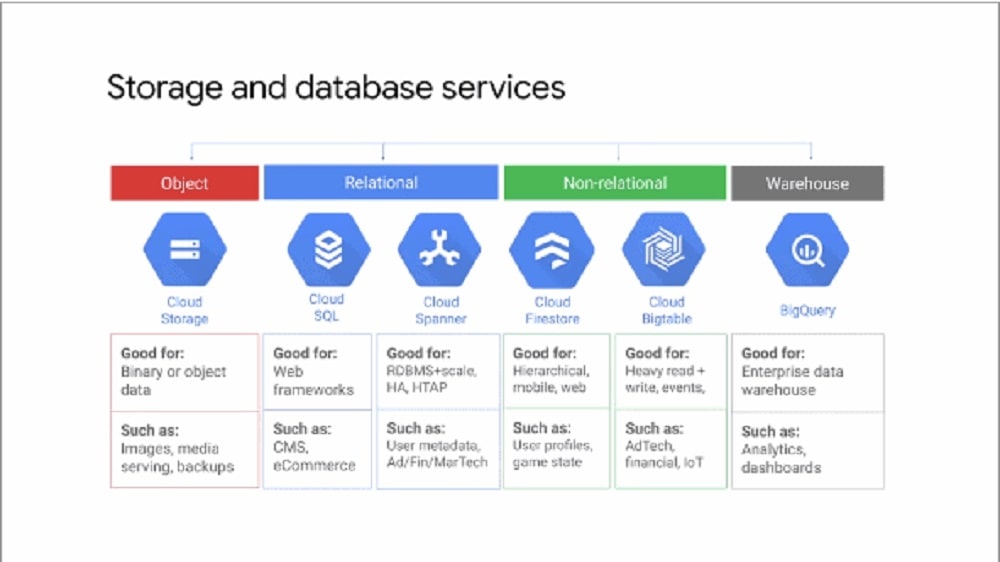
Google Cloud handle the entire process of configuring, scaling, managing and backing up your databases in the public or hybrid cloud so you can focus on other parts of your project
The managed databases-as-a-service (DBaaS) that AWS and GCP provide are very similar. In this service, they handle the entire process of configuring, scaling, managing and backing up your databases in the public or hybrid cloud so you can focus on other parts of your project. The only difference between both providers is the names they use and their pricing, which vary due to several factors.
Both AWS and GCP Empower Seamless Data Access and Collaboration

AWS offers application integration and API management to connect and manage multiple services within its ecosystem and external applications.
Both AWS and GCP provide application integration and API management for connecting and managing multiple services within their ecosystem and external applications. They also provide numerous SDKs and client libraries to enable you integrate popular programming languages and platforms.
Google Cloud Excels in Load Balancing Speed and Ease of Configuration

Google Cloud Platform network services include cloud load balancing, Cloud DNS and Cloud VPN
Google Cloud Platform’s network services include Cloud Load Balancing, Cloud DNS and Cloud VPN. AWS’s services include Amazon Route 53, Amazon Direct Connect and Amazon Virtual Private Cloud (VPC). Both cloud providers offer very powerful networking capabilities. But Google’s load balancing is faster than AWS. Also, since Google already handles some of the technical details, configuring load balancers on GCP is easier than on AWS.
08 Google Cloud (GCP) vs AWS Activate: Which is the best for your business?
Google Cloud (GCP) is the best tool for you if:
- You’re developing open-source and DevOps-centric projects
- You’re interested in a hybrid cloud environment because Google provides the most advanced
- Budget is a concern, and you appreciate a simpler pricing system
- You’re processing large datasets
- You want to enjoy a better developer experience
 You’re developing open-source and DevOps-centric projects
AWS Activate is the best tool for you if:
- Your organisation prefers an innovative, fast-paced environment
- You want more control over your virtual environment as AWS doesn’t handle most of the underlying technical detail GCP takes care of
- You need a platform with more supporting services and third-party integrations
- You’re looking for career development and need international certification and compliance since AWS has a much larger job market
- You value a broad global presence, as AWS has data centers in multiple regions, ensuring low-latency access for your users
Google Cloud (GCP)
Used by 11245 members
$2,000 in credits for 1 year if you never raised funds // $350,000 in credits for 2 years if you did
Save up to $350,000
AWS Activate
Used by 6104 members
Up to $100,000 in credits or 20-50% off your monthly spend through an AWS partner (must be spending $100+/month)
Save up to $300,000
09 Alternatives to Google Cloud (GCP) & AWS Activate

Google Workspace
Used by 9003 members
20% off Plus plans for 1 year
Save up to $518

DigitalOcean
Used by 6924 members
$200 in credits
Save up to $200

Typeform
Used by 4566 members
40% off all annual plans
Save up to $1,236

Microsoft Azure
Used by 2398 members
$5,000 in credits for 6 months if you didn't raise funds // Up to $150,000 in credits for 2 years if you did
Save up to $150,000
10 Promotions on Cloud Computing software
Google Cloud (GCP) and AWS Activate are great tools, but Secret offers promo codes with discounts on over 2190+ different SaaS solutions. New deals are added regularly, helping you save money on your online subscriptions. Get access to codes for other Cloud Computing software you might want to purchase
DigitalOcean coupon code 2026
$200 in credits

Discount for OVHcloud
€10,000 in credits for 1 year

Cloudways deal
30% off for 3 months

Cloudflare promo code
$5,000 in credits for self-funded startups // $250,000 in credits funded startups

Promo code for Scalingo
€1,000 in credits for 6 months

Promo codes for Hostinger
Additional 10% off on all 12/24/48-monthly plan purchases

mongoDB offer
$500 in credits for 1 year

Galaxy (ex. Meteor Cloud) promotion
$600 in credits for 1 year

Promo code Amazon EC2
Up to $100,000 in credits or 20-50% off your monthly spend through an AWS partner (must be spending $100+/month)

Code for Snowflake
$1,250 in credits
Start saving on the best SaaS
Secret has already helped tens of thousands of startups save millions on the best SaaS like Microsoft Teams, Google Workspace & many more. Join Secret now to buy software the smart way.